Depot Charging vs Public Charging: What 86 MWh of Real-World Data Shows
Alzbeta Lietava
Electrification Expert
Public charging gets electric fleets moving, but a charger at the depot keeps them dependable. See what 86 MWh of real charging data from six Quebec fleets shows, and how to plan the right mix.
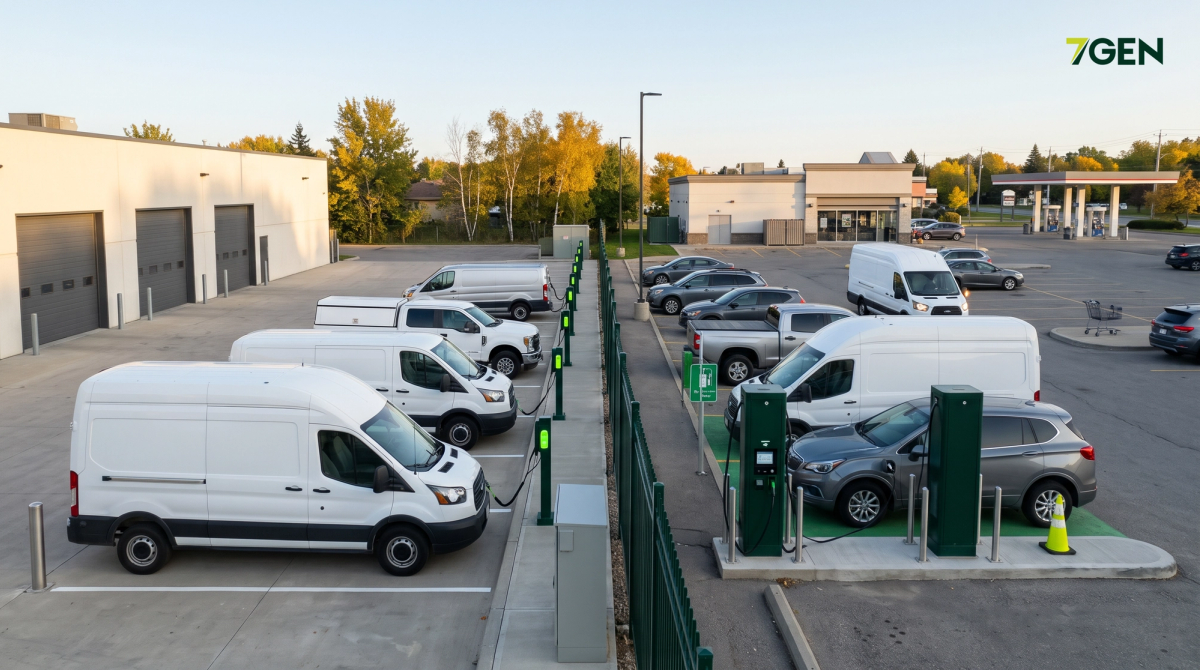
Electric delivery vans plugged in at a private depot, beside a crowded public charging lot, separated by a green fence
Depot charging vs public charging looks like a choice between two ways to refuel. In practice it decides whether your vans start the day ready or start it looking for a charger. For fleet managers working on fleet electrification and zero emission vehicles (ZEVs), public charging is not a charging strategy. It's only a backup plan. This guide explains how each option works, what each costs and where each fits. It then shows what six Quebec delivery fleets show us about getting the mix right, with about 86 MWh of real charging data.
What is the difference between depot charging and public charging?
EV fleet charging refers to the chargers, power and planning that keep a group of electric vehicles ready for work. Depot charging happens at your own base, usually overnight, on chargers you control. Public charging uses EV charging stations open to EV drivers and EV owners of every kind, on someone else's schedule and price. Depot charging suits vans that return to base every night. Public charging suits long routes and flexible work, and it supports operations across multiple cities and regions.
Depot charging usually means Level 2, which refills a van while it parks. Public charging is often a direct current fast charger, which is quicker but costs more per kWh. This applies to light duty vehicles such as vans and pickup trucks. Medium and heavy duty vehicles often need DC fast charging at the depot as well. Reliable EV fleet charging starts with knowing which job each one does.
Depot charging vs public charging: which is more reliable for fleets?
Depot charging is more reliable for fleet operators. A van that depends on a charger you do not own cannot reserve it, so the route plan bends around the charger. At a depot, every van has its own charger and a start time you set, which helps minimize downtime.
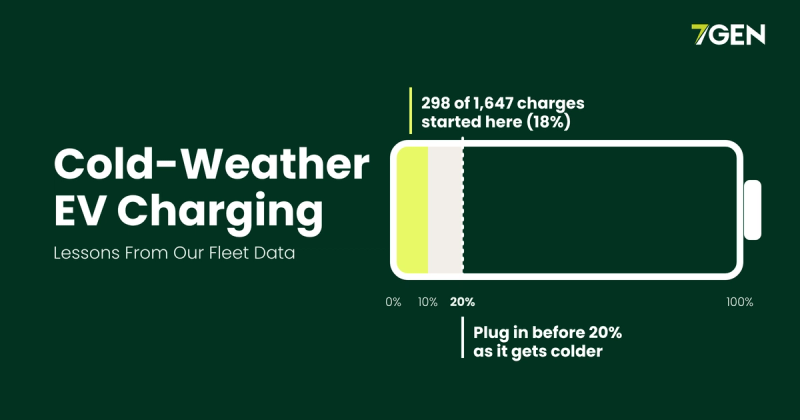
Winter raises the stakes. In CAA's test of passenger EVs at -7 °C to -15 °C, range came in 14% to 39% below the official rating, and cold slows charging until the battery warms. A van that starts a winter charge near empty has less range to spare and takes longer to recover, and doing it as a habit is harder on battery life. Our cold-weather charging post has the winter rules, starting with plugging in before 20%.
Depot charging vs public charging: what does each cost?
What does public charging cost?
Public charging lets a fleet start without capital costs, infrastructure installation or electrical work. Over time it is harder to budget. Circuit électrique (in English) lists fast charging at $0.38 to $0.62 per kWh, indexed each year. Level 2 is priced by each station owner, from $0.25 to $3 per hour or $0 to $20 per session.
What does depot charging cost?
Depot charging costs more up front. You pay for EV chargers, infrastructure installation and sometimes electrical infrastructure upgrades, which often means work on the panel and the service, especially in existing buildings. Maintenance costs are part of the picture too. In return, the electricity runs through your own meter, so your electric vehicle charging costs are easier to forecast, and overnight charging can use lower off-peak electricity rates where your utility offers them. This is where 7Gen changes the math: we install and maintain the chargers, and their cost sits in the same monthly payment as the vans, so you compare one number with your fuel costs today.
Will more public EV charging infrastructure solve it?
It will help, but it will stay shared. NRCan's charging infrastructure report (in English) estimates that Canada will need about 679,000 public charging ports by 2040, roughly 40,000 new ports a year from 2025. It puts cumulative capital costs for public light duty charging at nearly $18 billion by 2040, and it estimates that the grid upgrades needed to meet EV demand could reach a mid-range $94 billion from 2025 to 2040, about $3,000 per light duty vehicle. Even so, a public port is never reserved for your van, so it cannot replace a charger at your depot.
Medium and heavy duty vehicles, from delivery trucks to public transit buses, add to the load. The report projects about 275,000 public ports for them by 2040 and $47 billion in capital investment to support that public charging. It also projects 22,500 MW of energy demand from charging by 2040, so energy management matters at your depot early. Some depots add energy storage or other distributed energy resources to handle peaks.
Are there financial incentives for depot charging?
Often, yes, and they can lower costs a lot. An electric fleet charging program can provide funding for part of the installation, and infrastructure incentives often reimburse costs only after approval, so get pre-approved before you order. Costs you incur before you have received pre approval are not eligible. In British Columbia, the CleanBC Go Electric Fleet Charging Program (in English) has paid 50% of eligible project costs, and 75% for Indigenous communities. It works on a first come, first served basis and offers free advice from a ZEV fleet advisor. Indigenous organizations should check the program page for their own rates, and BC Hydro customers use BC Hydro's own program for assessments.
Federally, Budget 2022 added $400 million to NRCan's Zero Emission Vehicle Infrastructure Program (in English), which aims to add 50,000 ZEV chargers and runs to March 31, 2027. Check current intake and any additional funding before you plan around a program.
What is the best charging strategy for a fleet depot?
Use a hybrid approach to EV fleet charging. Make depot or home charging the base for your electric fleet, keep public fast charging for long days and emergencies, and size the plan from your own telematics. A van that drives about 126 km a day and parks overnight is a natural fit for Level 2, because the energy it used can go back in while it sits.
Start with three numbers from your own fleet: how many kWh each van uses a day, when it parks, and how long it sits. They set your energy requirements, which tell you where to install chargers, how many you need and how much power the site must supply. A fleet assessment is the next step, and it helps you reduce costs by sizing the site to the fleet and not to a guess. To see why that matters, look at how a real fleet charges today.
What does real-world charging data from six Quebec fleets show?
Everything above is the theory. Here is how it plays out in a real use case: six Quebec delivery fleets leasing through 7Gen that run on a mix of public and private charging. They already get their routes done, so the question is how much more dependable that mix can be. First, where their energy came from. Then, what we would optimize.
Where the energy came from
Most of the energy came from public chargers, about 59%. Another 20% came from fast chargers that are not on public maps, and 18% from private overnight sites. Less than one kWh in five was charged somewhere the fleet controls.
This is MyGeotab data on 34 electric delivery vans from July 20 to October 18, 2026: 1,647 charging sessions, about 86 MWh and roughly 126 km a day per van. The shares are rounded, and about 2% could not be classified. We matched each session to the Natural Resources Canada (NRCan) public charger locator within 150 metres. A slow overnight session with no station nearby counts as private. A fast charger above 20 kW with no match counts as not on public maps. This is a small sample, so read it as a real example and not an industry average.
The biggest gain sits with a small group of vans. 18% of charges began at 10% battery or less, which is 298 of 1,647 sessions, and in four of the six fleets just 8 of the 30 vans made 65% of them. Those vans are where a depot charger helps first.
What we would optimize
First, put overnight Level 2 on those few vans, at charging locations where they already park overnight, since a handful of chargers is a small first install. Second, make depot or home charging the base for every van that parks overnight, and keep public and fast charging for long days. Third, track the plug-in-before-20% habit with fleet reports that list each van's low-battery starts, so drivers can be coached before winter.
Public charging got these fleets moving. A charger at the depot is what makes them dependable. Start by checking where your own vans charged last month.
How can 7Gen help?
7Gen builds the charging plan for you. We lease the vans, install and maintain the depot chargers, and provide the fleet software, all under one contract, so charging is built around your routes and not left to whatever public charger is free. Our EV fleet charging solutions start from your telematics, so we size depot charging from what your vans actually do. That turns EV fleet management into lower costs and real cost savings, and helps you reduce GHG emissions and build a more sustainable future without missing a route.
→ Use our free TCO Calculator to compare EV vs. ICE fleet costs for your operation.
Ready to plan charging for your fleet? Get a Quote
Ready to Electrify Your Fleet?
Get expert guidance on transitioning to electric vehicles. Our team is ready to help.
Get a Quote