Cold-Weather EV Charging: Lessons From Our Fleet Data
Alzbeta Lietava
Electrification Expert
Cold weather cuts EV range and slows charging. See what CAA’s winter test found, what our fleet data shows about low-battery starts, and six rules to get your vans winter ready.
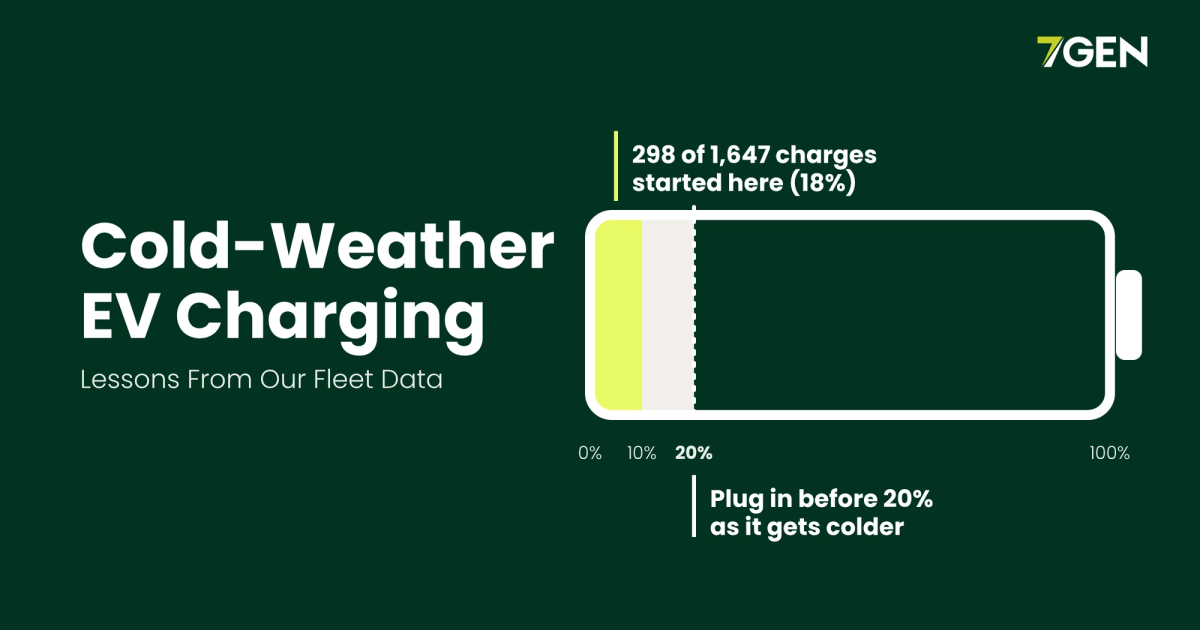
Battery graphic showing 18% of fleet charges starting at 10% battery or less, with a marker at 20% to plug in before winter.
Winter range is the first worry fleet managers raise about electric vehicles. Cold temperatures cut range, slow charging, and nobody wants a van stranded on a delivery day. In 7Gen’s own fleet data, most of the charges that start near empty come from just a few vans.
This guide covers cold weather EV charging for fleets: what the cold does to range, what our fleet data shows, and six winter rules that make EV fleet winter readiness simple.
How Much Range Do Electric Fleets Lose in Winter?
In the CAA winter EV test, EVs lost 14% to 39% of their official driving range at -7 °C to -15 °C. NRCan’s Green Fleet Best Practices Guide puts the winter cut to zero-emission vehicle range at up to 30%. Individual models in CAA’s test went higher, up to 39%. Gas and diesel vehicles feel the cold too: NRCan cites a U.S. EPA estimate that a drop from 24 °C to 7 °C can raise fuel consumption in urban commutes by 12% to 28%.
The test ran from Ottawa to Mont Tremblant with 14 EVs, measured against the official range NRCan publishes, a year-round average estimate. It included the Chevrolet Equinox EV. The Chevrolet Silverado EV started at 73% state of charge, so CAA adjusted its result. It and the Polestar 2 lost the least range at 14%, and the Volvo XC40 Recharge lost the most at 39%. These were passenger electric cars, not delivery vans, so the results are a guide for fleets, not a forecast for any one van. NRCan’s guide says real range can differ from the published estimate because of driving habits, cargo weight and temperature, so a loaded delivery van can differ from a passenger car. In CAA’s survey, more than 65% of Canadian EV owners reported lower battery range in extreme cold weather, and 4 in 10 EV drivers called slower charging in extreme cold a problem. In cold climates, plan for less range than the rated number.
Why Is Cold Weather EV Charging Slower?
It comes down to battery chemistry. Cold temperatures thicken the electrolyte and raise internal resistance, so lithium ions move more slowly. The battery management system then limits the charging rate to protect the pack. The effect is temporary and clears as the internal battery temperature rises.
EV batteries perform best within an optimum temperature range, and lithium-ion cells need their ideal temperatures to deliver full capacity, so in freezing temperatures a DC fast charger often means slower charging speeds until the battery warms. CAA’s test shows the spread, and CAA calls charging speed a critical factor on longer trips. A 15-minute DC fast charge added about 100 km of range on average, but the Tesla Model 3 added 205 km while the Toyota bZ4X added 19 km. In the same conditions, charging from 10% to 80% took 33 to 92 minutes depending on the model. The results highlight the gap between models.
What Does Our Fleet Data Show Before Winter?
Across 34 electric delivery vans, 298 of 1,647 charges (18%) started at 10% battery or less. In four of the six fleets, the two vans with the most of these low-battery starts (8 of 30 vans) made 191 of the 295 in those fleets, or 65%.
The other two fleets had almost none, and the data covers Jul 20 to Oct 18, 2026, so it shows summer and early fall charging, not winter performance. In CAA’s winter test, range fell by 14% to 39%, so a near-empty start leaves less margin when the cold arrives. Two of our fleet reports recommend that drivers plug in before 20% as it gets colder, and most point to a depot or home Level 2 setup.
Running a battery near empty is also hard on its long-term health. Our EV battery degradation data post explains how charging habits affect battery life.
What Are the Best Winter EV Charging Tips for Fleets?
Plug in before 20%, charge overnight, warm vans while they are still plugged in, keep snow and ice off vans, inspect cables and connectors before the cold arrives, and plan routes on winter range. These six habits form the core of EV fleet winter readiness when winter conditions hit.
- Plug in before 20%. As the temperature drops, a low battery has less range to give and takes longer to recover. Our support team’s winter driving tips say the same: avoid deeply depleted charge in extreme cold.
- Charge overnight wherever possible. Our winter driving tips say to keep the EV plugged in overnight, so grid power warms the battery and cabin.
- Use EV preconditioning. Warm the cabin while the van is still plugged in, using scheduled departure if it is available, so grid power does the work instead of battery power. Conditioning the battery before a DC fast charge helps a cold battery charge faster. NRCan’s guide lists both as ways to limit winter range loss. Cabin heat uses significant energy from the battery, so start with seat heaters and the heated steering wheel, since heated seats use less energy than the cabin heater.
- Clear snow and ice, and check tire pressure. Snow and ice add weight and drag. Cold air also lowers tire pressure, and underinflated tires add rolling resistance and cut range. Park indoors or in a sheltered spot when you can, which helps with maintaining battery temperature. For winter driving on slick roads, set regenerative braking to low or off, as our winter driving tips advise.
- Check chargers, cables and connectors before the cold sets in. Inspect the cable, connector and port before each charge. Keep cables holstered or retracted, not on the ground. Add a quarterly connector and cable check to your maintenance schedule.
- Plan routes on winter range, not the rated number. Test your longest route against the largest loss in the CAA test, and map backup DC fast charging stations along each route.
How Can You Check EV Range in Winter on Your Own Routes?
Start with your longest route, not your average. Pull your longest day from your telematics data, which NRCan’s guide says helps determine the range a fleet needs. Then subtract the largest loss in CAA’s test, 39%, from the van’s official range. If the route still fits with a buffer, you have a margin for winter.
Averages hide the long days: a van rated for 250 km may have only about 150 km of range after a 39% loss in cold weather. That may cover an average day, but not a longer route.
→ Use our free EV Range Comparison tool to check winter range on your own routes.
How Does 7Gen Help Fleets Through Winter?
7Gen leases the vans and installs and maintains the chargers under one monthly cost. Our fleet reports list the charges that start at 10% or less for every van, so those starts can be reviewed with drivers before the winter season starts.
If a cable, plug or charger needs attention, customers can create a support ticket in the customer portal.
Ready to Electrify Your Fleet?
Get expert guidance on transitioning to electric vehicles. Our team is ready to help.
Get a Quote