Electric Box Truck Savings in Canada: What a Year of Real Class 6 Data Shows
Alzbeta Lietava
Electrification Expert
FedEx says each electric truck will save $20,000 a year. Real B.C. Class 6 data shows when that holds, and what changes across Canada.
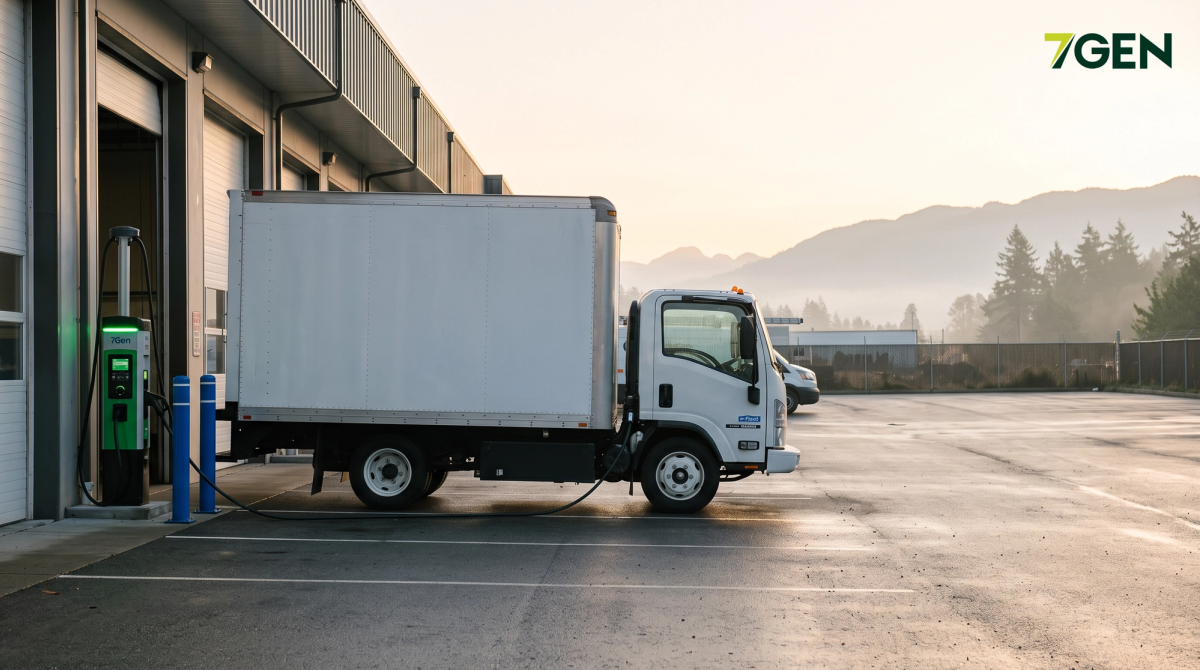
An electric delivery truck charging at a depot at sunrise.
Electric Box Truck Savings in Canada: What a Year of Real Class 6 Data Shows
FedEx just ordered 2,000 electric trucks from Harbinger in a deal worth more than $300 million. Harbinger estimates each truck will save $20,000 a year in fuel costs. Across 2,000 trucks and the 20-year service life Harbinger assumes, that adds up to $800 million.
Fleets across Canada are asking the same question: does the math work for us? For the right routes, it does. Here is how it works, using real B.C. data from a project we worked on and our own models. We also cover what changes from one province to the next.
Why delivery routes are where electric fleets start
FedEx’s order covers Class 5 and 6 delivery trucks for a pickup and delivery service that spans the US and Canada. Deliveries start at the end of 2027, and the company wants that service fully electric by 2040, according to Electrive (in English). The choice makes sense. Routes are predictable. Trucks return to the depot every night, so a full charge fits the shift. Stop-and-go traffic helps too, because regenerative braking recovers energy that a diesel truck loses as heat.
Battery-electric trucks also have zero tailpipe emissions, so they reduce emissions where deliveries happen, in dense city streets. And electric trucks are increasingly common in other countries. The ICCT (in English) reports that nearly 30% of heavy trucks sold in China in 2025 were fully electric.
How the math works on a real route
From November 2023 to November 2024, four electric Class 6 trucks ran furniture deliveries in B.C. in a project we worked on with GoBolt. The province published the results on its Class 6 delivery truck project page (in English).
| Measure | Result |
|---|---|
| Trucks | 4 battery-electric Class 6 |
| Distance driven | 79,417 km |
| Average day | 95.3 km |
| Energy use while driving | 68.9 kWh per 100 km |
| Fuel savings vs diesel | $34,481 |
| CO2 avoided | 51,289 kg |
The 68.9 kWh per 100 km shows the trucks’ energy efficiency on real routes. The province’s fuel savings work out to about 43 cents per kilometre. These trucks averaged 95 km a day, a modest duty cycle for a delivery truck. A truck driving 40,000 km a year at the same rate would save about $17,400 in fuel. Reaching $20,000 takes about 46,000 km a year.
Working back from the totals, each B.C. truck ran about 208 days. At that pace, 40,000 km is about 190 km a day and 46,000 km is about 220 km a day, roughly double what these trucks averaged. So Harbinger’s estimate is in the right range for a busy delivery truck, and the distance each truck drives is the biggest lever.
Three limits apply. The data covers fuel only, with no maintenance or carbon credits. The province’s page does not say whether the savings figure is net of electricity or what diesel price it assumes, so treat it as a measured benchmark, not a guarantee. And diesel prices have moved since 2024. Lower prices at the pump would shrink these savings, and higher prices would grow them.
When you test any savings claim, ask three questions. Is it per year or for the whole life of the truck? Who made the estimate? Does it compare fuel costs and energy costs on the same basis, so that fuel saved is net of the cost of electricity? Electrek (in English) credits the $20,000 estimate to Harbinger and does not say whether it is net of electricity costs.
What the full picture looks like for a box truck
Fuel is one piece. We modelled a 10-truck fleet of Class 3 to 5 box trucks in B.C., driving 40,000 km a year, with diesel at $2.00 per litre. Per truck, diesel costs about $1,557 a month and electricity about $292. That is roughly $15,200 saved in fuel and energy per year. In per-kilometre terms, that is about 47 cents for diesel and 9 cents for electricity, a gap of about 38 cents, in the same range as the 43 cents measured in B.C. It is a model of smaller box trucks, so it will not match the measured Class 6 figure exactly.
Fuel savings do not cover the whole gap on a box truck. An electric truck carries a price premium, so the lease payment is higher, about $3,059 a month against $1,224 for diesel in our model. Incentives and carbon credits are what turn that gap into a lower cost over the term. Our guide to B.C. Go Electric rebates covers the rebate side.
Where carbon credits come in
Every kilowatt-hour an electric truck draws can earn credits under the federal Clean Fuel Regulations, which apply across Canada. Some provinces run their own programs too, such as B.C.’s Low Carbon Fuel Standard. The operator is responsible for registering, tracking and selling the credits through its charging setup. We handle that for our customers. Federal credit prices crossed $400 in 2026, as we explain in our CFR credit price breakdown.
This example uses B.C. inputs. For this box truck, our Carbon Credit Revenue Estimator models about $18,700 per truck per year. That is well above the roughly $7,700 a year by which the electric truck costs more to lease and run in our model, after fuel savings and other operating costs, so the credits can offset the premium. These are modelled figures, and your province and charging setup will change them.
Carbon pricing is not only a Canadian idea. The World Bank counted 68 carbon pricing programs, which it calls instruments, in operation as of 2022. The Paris Agreement, adopted in 2015, includes Article 6, which lets countries cooperate through carbon markets, and at COP29 in 2024 negotiators finalized the rules for international carbon credit trading. A separate voluntary market also grew quickly. Forest Trends (in English), citing Ecosystem Marketplace, put its value at about $748 million in the first eight months of 2021, up from about $473 million in the same period of 2020. Fleet credits in Canada run under federal and provincial rules instead, but the direction is the same: emissions carry a price.
What changes from province to province
The B.C. numbers are one example. Four things move the answer elsewhere: your diesel price, your electricity rate, the incentives you can claim, and which carbon credit programs apply to your charging. Electricity rates differ widely between provinces, and incentives change often, so check current federal and provincial programs before you plan.
Climate matters too. The B.C. data comes from a mild coastal climate. In colder regions, winter can raise energy use and shorten range, so test your routes in your coldest season.
What we see with delivery vans
Delivery vans are often an easier case than box trucks, because a smaller vehicle usually carries a smaller price premium for fuel savings to cover. In our model, a cargo van driving 40,000 km a year saves about $320 a month before incentives and carbon credits. Carbon credits can add several thousand dollars per vehicle per year, and the amount depends on your province and charging setup.
What else changes beyond fuel
The money question goes beyond fuel. An electric drivetrain has far fewer moving parts than a diesel engine, and it needs no oil changes. Regenerative braking also means the friction brakes do less of the stopping, so rotors and pads should see less use. Those points could lower maintenance costs and potentially reduce downtime, but we did not measure maintenance in the B.C. data, so treat them as expected benefits, not proven savings. Fleets still maintain tires, brakes and suspension on an electric truck.
Quiet operation is another gain. Electric trucks run much quieter than diesel, which drivers notice quickly and which helps fleet owners who deliver early in residential areas.
Range and equipment vary by model, and actual range can vary based on load, driver behaviour and weather. Freightliner lists a typical range of 180 or 250 miles (about 290 or 400 km) for its eM2, for example, and about 60 minutes to charge to 80% on the Class 6 version (about 90 minutes for Class 7). Its gross vehicle weight rating runs from 26,000 to 33,000 lb, so check the payload you need for your body and equipment before you choose a configuration. Compare the spec sheet for each model, and test range on your own routes with our EV Range calculator.
Three ways to get there
Whichever path you take, compare electric and diesel on total cost of ownership. It counts every cost over a vehicle’s life, including maintenance, driver training and disposal, and it adjusts future costs to today’s value. Leaving any of that out can lead to poor investment decisions. Our EV vs diesel total cost of ownership guide walks through the method, and electric last mile solutions for Canadian delivery fleets covers delivery routes in particular.
Buy and run it yourself
FedEx’s order works out to at least about $150,000 per truck, going by the order value. If your company has the capital, you can buy the trucks, install the chargers, claim the rebates and register and sell the carbon credits yourself. You keep full control, and you also take on the work and the risk.
Lease with 7Gen
Most fleets would rather keep that capital working elsewhere. 7Gen leases the vehicles, installs the chargers, and runs the software and the carbon credits under one contract, so more fleets can operate electric trucks without a large capital outlay. Our team supports your fleet from the first lease through the carbon credits. → Get a Quote
Start with your own numbers
If you are not sure yet, begin with your routes. Pick the ones that return to the depot every night and run a steady distance, then run them through the calculator. Several factors drive the answer, so account for each: how far each truck drives, your diesel price, charging power and cost, and which incentives and credits you can claim.
→ Use our free TCO Calculator to compare EV vs. ICE fleet costs for your operation.
Quick answers
How much do electric box trucks save per year?
In B.C. data from four Class 6 trucks, fuel savings were about 43 cents per kilometre. At 40,000 km a year, that is about $17,400. Our calculator models about $15,200 for a Class 3 to 5 box truck. Rebates and carbon credits are separate from those figures.
Is FedEx’s $800 million a yearly figure?
No. It is a lifetime estimate: 2,000 trucks times $20,000 a year times 20 years. The $20,000 per truck and the 20-year service life are Harbinger’s assumptions, and the $800 million is the total over 20 years.
How far does a truck need to drive to save $20,000 a year?
About 46,000 km a year at the 43 cents per kilometre measured in B.C. Your savings per kilometre will move with diesel and electricity prices.
Do these numbers apply outside B.C.?
The per-kilometre result is measured in B.C., and the box truck figures are modelled with B.C. inputs. Your province will change diesel prices, electricity rates, incentives and credits, so run your own numbers in the calculator.
Ready to Electrify Your Fleet?
Get expert guidance on transitioning to electric vehicles. Our team is ready to help.
Get a Quote